
the Damara Difference
Damara are not a delicate sheep. They are equally at home in desert country, poor or lush paddocks alike or of course – in the scrubby Australian bush. They browsers as much as grazers who will work through shrubs, woody growth, and broadleaf weeds alongside pasture, making them particularly useful where you are managing mixed or unimproved country. They don’t demand ideal grass conditions, though they will thrive there too. Damara are intelligent and strongly flock orientated. A good, secure boundary is generally respected, and you will always find them together as a flock – they don’t scatter or wander off on their own. Our flock will cover kilometres of country during the day and still return home together each evening. They are also widely well regarded for their parasite resistance, including a higher natural tolerance to internal burdens than many traditional sheep breeds. Sound management still matters, but they are not fragile sheep requiring constant intervention. This is a real advantage for low input or organic leaning setups.
They have exceptional feed conversion rates, due to their evolution in regions where feed availability is highly variable and pasture quality frequently declines across seasons. Their fat tail adaptation allows them to draw on body reserves during periods of feed shortage and recover condition when feed returns. Australian research has put this reputation to the test. A University of Adelaide study comparing Damara and Merino sheep found that Damaras achieved better dry matter digestibility across both low and high quality diets — and extracted meaningfully more usable energy from the same feed (Wilkes, Hynd & Pitchford, 2012). The most telling result came under poor quality feeding conditions. Damaras continued to gain weight while Merinos on the same diet lost weight — a clear indicator of the breed’s capacity to extract usable energy when feed quality is at its worst (Wilkes, Hynd & Pitchford, 2012). Separate Australian feeding trials comparing Damara, Dorper and Merino sheep under both restricted and growth diets reached similar conclusions. Damaras consistently maintained better body condition and growth rates under nutritional stress — the kind of conditions typical of dry or low rainfall areas (Scanlon et al., 2013). For those running sheep in environments where their paddocks and pasture is unreliable, this digestive efficiency translates to lower input requirements and more consistent health and performance across variable seasons.
~10% higher
digestible energy intake compared to Merinos, on both low- and high-quality diets
Wilkes, Hynd & Pitchford, 2012
+38 g/day
Damara weight gain on poor-quality diet — Merinos lost 28 g/day on the same feed
Wilkes, Hynd & Pitchford, 2012
Better condition under restriction
Outperformed Dorper and Merino on both restricted
and growth diets
Scanlon et al., 2013
Furthermore, as a hair sheep, Damara do not require shearing. Lambs are born with a soft woolly coat that protects them early on, which naturally sheds as they mature. Removing the need for annual shearing significantly reduces labour and handling stress — particularly important for low input operations. They breed year-round rather than being strictly seasonal, allowing flexibility in management – and where the setup suits, a ram can run with the flock full-time rather than being joined only for a set period. Ewes are capable, attentive mothers, with strong protective instincts, and lambing is generally straightforward. They raise twins with ease and are capable of producing lambs every eight months in good conditions with a longer productive life than most other breeds.
For those interested in producing their own meat, Damara offer lean, full-flavoured cuts. They store most of their fat in their characteristic tail rather than throughout the body, resulting in clean meat with little fat, but still full flavour. The tail fat itself can be rendered and used in cooking, and their hides can be tanned and utilised, making them well suited to a more self-reliant, whole-animal, no-waste approach. Furthermore, due to their feed conversion rates and natural parasite resistance, they can thrive in organic setups.
We do find them to be quite extraordinary, we are glad we chose them and are proud to be raising them. Damara have much to offer farms, homesteads, and small holdings across Australia, and we hope to see their numbers continue to grow so more people can experience working and living with this remarkable breed.
Damara Trait list
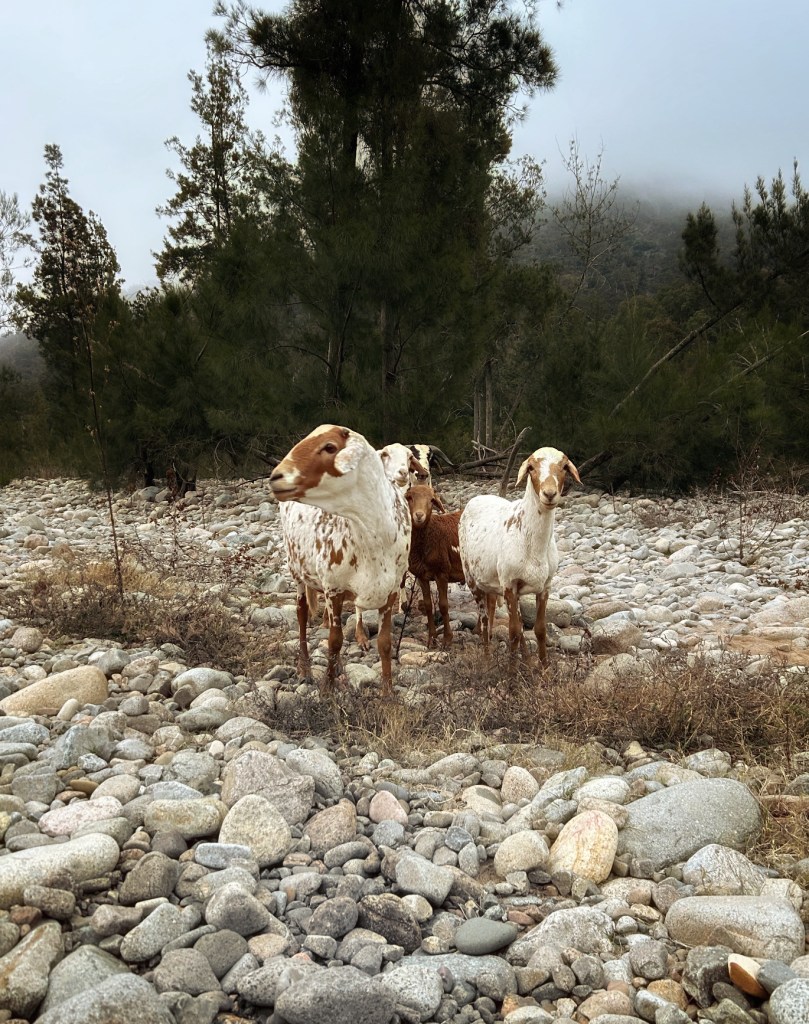
The following traits are listed by the Damara Sheep Breeders Society. The Society webpage has lots of great Damara information – we recommend a visit.
–Typically alert, lively, long-legged, large deep bodies with pronounced brisket.
–Short hair coat that lengthens and fills with wool in the winter in colder areas. This is shed in summer months.
–Lambs have a longer hair coat, often referred to as a “Baby Coat”. This “baby coat” retains wool during the first two winters and is shed into the shorter adult coat during their second summer. Young Damara can be mistaken for cross breeds due to this fact.
–Coat texture can vary greatly from coarse to fine and some lambs even have curly hair coat.
–Colours varying from black, brown, white or all combinations of these. Every sheep has a distinct individual hide.
–Wedge shaped tail extends below the hock, stores body fat utilised in hard times, with minimal body fat distribution.
–Predominantly horned sheep, though polls do occur. Rams have large horns, spiral and straight.
–Long, mobile ears
–Small lobes (wattles) can occur under throat
–Rams have strong masculine heads pronounced horns, Roman noses, briskets and are livelier and more robust than ewes
–Ewes have finer bodies and appear more delicate and feminine
–Proven performers and good food converters
–Highly fertile with polyoestrous cycles, reaching sexual maturity as early as six to seven months, recommended first joining is 10-12 months
–Capable of producing three lambs in two years. Ewes have a five month gestational period (150 days, slightly longer than other sheep breeds), and lambs start grazing quickly. Ewes have strong mothering instincts, are protective and can cycle again as early as four weeks after lambing. Twins are not uncommon and are reared easily by mothers.
Damara History in Australia
The Damara’s history began not in Australia but in Namibia, at the Omatjienne Research Station near Otjiwarongo, where researchers in the late 1950s and early 1960s began formally documenting a breed the Himba and Tjimba peoples of Kaokoland had been managing for centuries. What the researchers found was an animal that had been shaped entirely by its environment — drought, distance, poor feed, no veterinary intervention — and had emerged from that pressure with characteristics no breeding program had deliberately engineered. The South African Damara Breeders’ Society was established in 1992, and within a few years South African breeders were exporting genetics to Australia, New Zealand, Canada and beyond.
The first Damara genetics entered Australia in 1996. They came in as embryos and semen, introduced into Western Australia from South Africa. From those founders, the Australian population has been built entirely from within — no subsequent importation of live animals has ever occurred. The early years of Damara breeding in Australia were concentrated in Western Australia and Queensland, with a handful of committed breeders establishing the flocks that would become the foundation of the documented population. Among the most significant is Sherana Damaras, run by Viv and Judy Forbes in Queensland. Sherana had one of the oldest and most varied flocks of guaranteed pure Damaras in Australia. Brae Park has been another significant force — a stud that made a critical preservation impact on the Australian population by capturing and documenting the fragmented lines across the country, including purchasing sheep from the main closing studs in the early 2000’s and 2010’s (click here if you would like to read about why Damara was not able to cross into Australian commercial farming) such as Sherana, rams from Sherana, Jarrara and Springmount. We are proud to say that 90% of our flock originated from Brae Park genetics. Jarrara Stud in Victoria also contributed meaningfully to the registered population. These studs, along with a small number of others, constitute the backbone of what exists here and you will find their influence among the growing number of dedicated studs across the country.
A major episode in Australian Damara history is the story of what became known as the Ice Babies — and it is worth telling, because it highlights both the fragility and the determination that characterise the breed’s establishment here. Thirteen years before they were born, a South African veterinarian collected 100 embryos from pure Damara ewes owned by leading South African breeder Petra Scholtz. Those embryos were frozen and exported to Australia, ending up with John and Mary te Kloot of Marmboo in Longreach, Queensland, where they were stored in liquid nitrogen for twelve years. Viv and Judy Forbes at Sherana were aware of their existence and, concerned the embryos would be lost, purchased them in 2012. A vet was found with the right experience for the implantation program — Francois Marais, who in a strange coincidence turned out to be the same veterinarian who had harvested the embryos in South Africa thirteen years earlier. The implanting operation took place on 30 April 2013, and of 97 embryos implanted into 50 ewes, 32 became pregnant. Forty-nine lambs were born, 44 survived — roughly 24 ewes and 20 rams. Forty-four animals from 100 embryos that had spent more than a decade in frozen storage. The Forbes described the result as possibly the last Damara genetics that will ever get into Australia from Africa.
The barrier to further importation is scrapie — a prion disease of sheep that Australia has never recorded in its domestic flock and intends to keep out. Importing sheep genetics from countries where scrapie exists, or cannot be ruled out, requires animals to carry a specific genetic profile — the ARR/ARR scrapie-resistant genotype — before their material qualifies for import under Australian biosecurity rules. The incidence of the ARR/ARR scrapie genotype in the Damara breed was found to be low in an importation program to the UK – which means finding sufficient donor animals that meet the import requirement is difficult and the regulatory pathway that once allowed embryo imports has effectively shrunk. South Africa, despite being the logical source of new genetics, cannot readily supply genetics that meets Australian biosecurity requirements for this reason.
The result is a closed population. What was brought in during the 1996 importation, supplemented by the Ice Babies program in 2013, is what the Australian Damara population has to work with. No new genetics from Africa are anticipated. The Damara is listed as endangered in Australia by the Rare Breeds Trust of Australia. The population is small, the registered stud network is limited, and the pressures on genetic diversity are real. At the same time, the breed’s qualities as a commercial animal have made it attractive as a terminal sire — which has driven the spread of Damara genetics through crossbreeding programs while doing little to grow the purebred registered population. This is the central tension in Australian Damara conservation. The breed’s usefulness has worked against its preservation as a purebred. The animals that make the best cross — hardy, fast-growing, low-input — are the same animals whose genetics disappear into a first generation of a mixed flock rather than being carried forward in future generations of Damara. The work of the Damara Sheep Breeders’ Society of Australia, and of the studs that maintain traceable, documented purebred lines, is the mechanism by which the breed’s future in Australia is being secured.
Thanks to The Damara Sheep Breeders Society for the information above – head to the DSBSA web page for more details, extra resources and guides.
Want to ask just some questions?? Contact us here, or head over and take a look at our flock in the Gallery or on the Meet the Flock page.
 WILD VALLEY DAMARA